
English • Market
Korean Pension CIOs Outline 2026 Strategies: “Diversify by Region and Secure Liquidity”
At CFA Korea’s annual investment conference, top CIOs share plans to broaden exposure to underexplored developed markets and move away from direct investments.
Amid global economic shifts and ongoing revaluation of real assets, Korea’s leading institutional investors are setting their sights on diversification and stability as key pillars of their 2026 investment strategies.
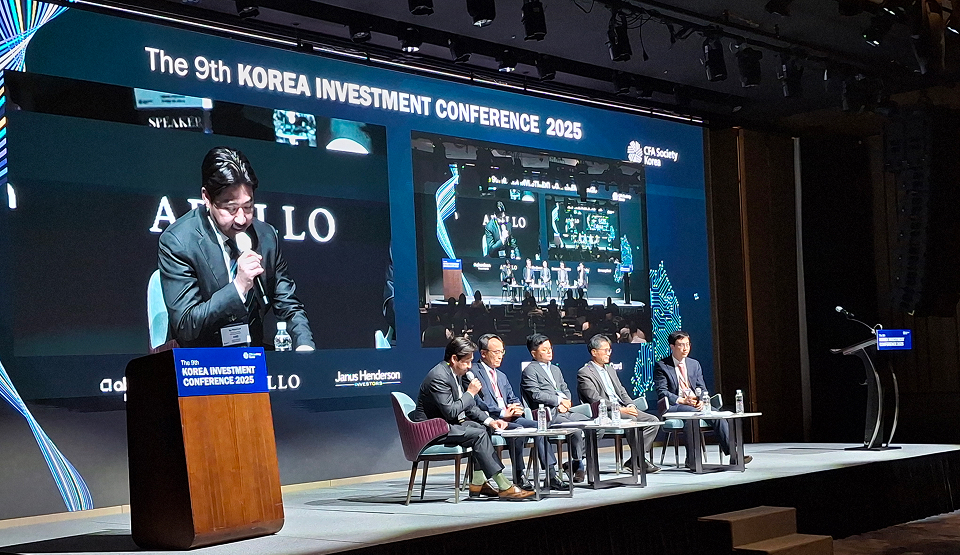
At the Korea Investment Conference 2025 (KIC 2025) hosted by CFA Society Korea on October 28 at the Fairmont Ambassador Seoul, several major CIOs discussed how they plan to navigate next year’s uncertain landscape under the theme “Institutional Investment Strategies in a Changing Global Paradigm.”
Panelists included Huh Jang, CIO of the Public Officials Benefit Association (POBA); Cho Sung-sik, CFO of Mirae Asset Life Insurance; Kim Jin-hwan, Head of Real Estate and Infrastructure at Teachers’ Pension (TP); and Park Yang-rae, CIO of the Korea Scientists and Engineers Mutual-Aid Association (SEMA).
Seeking Alpha Through Granular Diversification in Real Assets
POBA CIO Huh Jang emphasized “diversification” as the core of his 2026 strategy. Given the dual need for steady yield and controlled volatility — along with liquidity management — he said the fund aims to build a resilient, cycle-proof portfolio.
Over the past three years, more than 70% of POBA’s allocation has focused on income-generating assets such as private credit, which provide stable carry returns.
Looking ahead, Huh said the fund will enhance both geographic and asset-class diversification to mitigate concentration risk while targeting incremental alpha. Currently, about 65% of its overseas exposure is concentrated in the U.S. and Europe, but he plans to expand into developed yet underexplored APAC markets such as Australia and Japan.
He also stressed that within real estate, identifying niche sub-sectors capable of delivering excess returns will be critical going forward.
Pension Portfolios at a Crossroads
Teachers’ Pension’s Kim Jin-hwan acknowledged that achieving “stable returns” remains an elusive goal in practice. Rather than expanding into new themes, he said the fund is reassessing whether its current exposure to alternative assets is appropriate.
Kim added that maturing pensions must revisit traditional asset allocation frameworks and tranche structures, signaling potential rebalancing between traditional and alternative holdings.
From Direct to Blind-Fund Investments Abroad
SEMA CIO Park Yang-rae highlighted that the fund’s overseas real estate exposure — currently 70% of its 28% total real estate allocation — has suffered losses amid higher rates and weaker office markets.
Given limited access to local information and challenges in managing cross-border assets directly, SEMA plans to scale back direct overseas holdings and shift toward blind-pool fund commitments.
Domestically, the fund is increasing exposure to Korean real estate, bringing its local and overseas proportions to near parity. Park added that while infrastructure remains attractive for its long-term yield profile, viable domestic opportunities are scarce, pushing the fund toward more overseas projects.
Insurance Portfolios Under the K-ICS Framework
Mirae Asset Life’s CFO Cho Sung-sik underscored the growing importance of asset–liability value alignment under Korea’s new insurance capital rule, K-ICS, which measures liabilities at market value.
He explained that the insurer’s general account now focuses primarily on bonds and yield-oriented alternatives, while its separate account offers a wide range of options — from equities to MMFs — tailored to clients’ risk preferences.
“Volatility Is Opportunity”
In his opening remarks, CFA Society Korea Chair Jung Dong-woo (Managing Director, abrdn Korea) framed volatility as an opportunity rather than a threat.
“The global financial system is undergoing an unprecedented transformation, with volatility at historic highs,” Jung said. “But for finance professionals, volatility itself is opportunity — and this is precisely when insight and perspective matter most.”
CFA Institute, a global nonprofit organization with more than 200,000 members across 160 countries, aims to uphold the highest standards of ethics and professionalism in investment and financial management.
